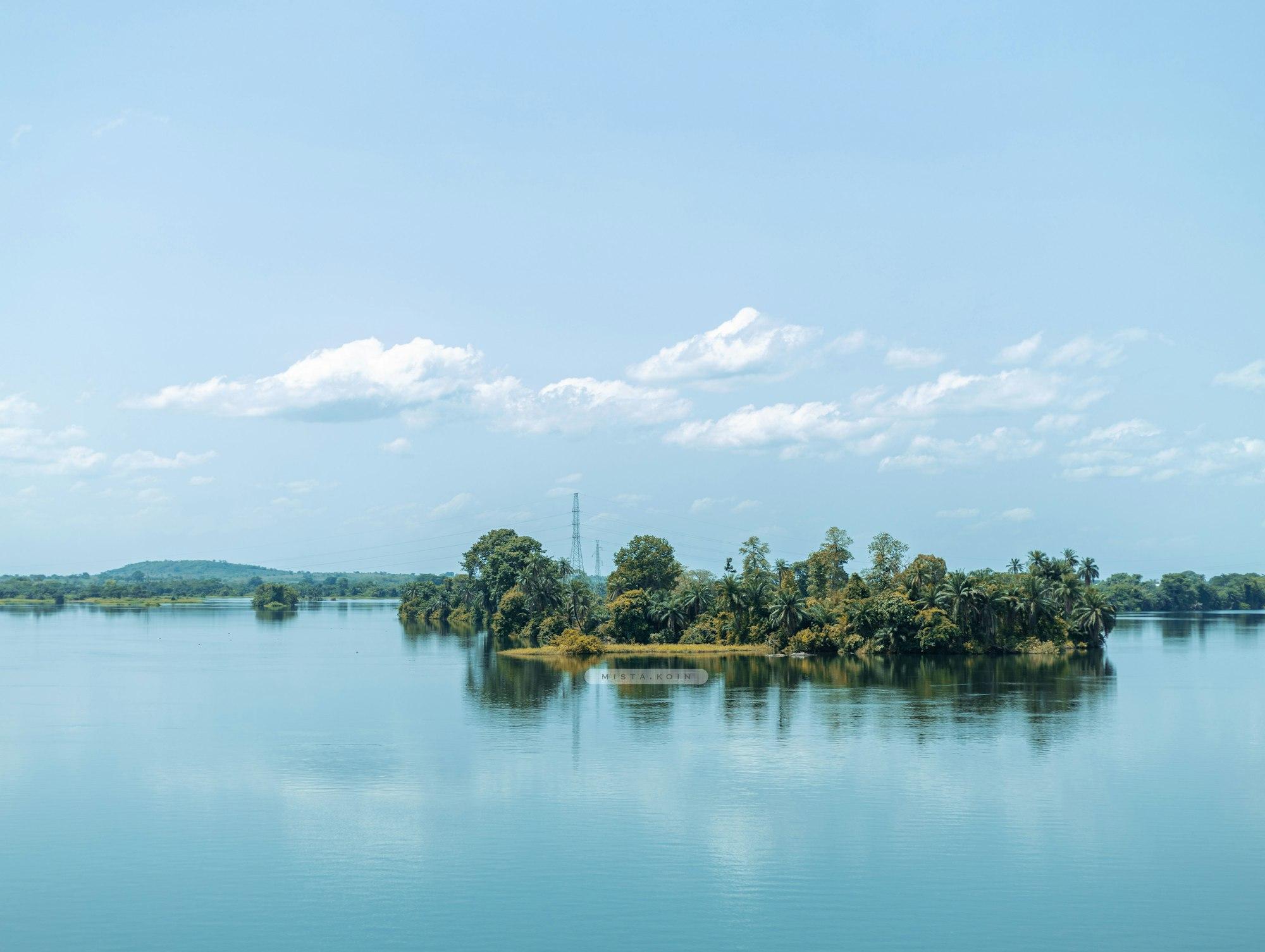
Few projects carry as much meaning in Ghana's history as the Akosombo Dam. Completed in 1965, it was a centrepiece of the country's post-independence ambition: cheap, reliable electricity to power industry, light homes and supply the aluminium smelter at Tema. Six decades on, it remains a cornerstone of Ghana's power system.
It is also one of the clearest examples of how a solution to one problem can create others — not because its builders were careless, but because the relationships the dam would disturb were treated as secondary to its main purpose.
What the lake changed
When the Volta River was dammed, it formed Lake Volta, one of the largest artificial lakes in the world, covering roughly 3,275 square miles (about 8,500 square kilometres) when full. According to historian Stephan Miescher, around 80,000 people were displaced from the flooded basin, and 52 resettlement townships were built to house them.
The resettlement did not go as planned. Miescher reports that by 1968 only 38.7 per cent of the original settlers remained in the new towns. Promised irrigation schemes failed, and farming conditions in many resettlement areas were poorer than those people had left.
Health effects followed. The still, warm waters of the lake created ideal conditions for the snails that transmit schistosomiasis. On the lake's western shores, infection among children under ten reportedly rose to 90 per cent, and some resettlement towns on the Afram arm recorded rates close to 100 per cent among children by 1968.
Downstream, the change in river flow transformed the Lower Volta. The estuary's clam fishery — an important source of income, particularly for women — largely disappeared. Miescher estimates that it had supported about 2,500 women.
Some changes were positive. The lake created a large new fishery: catches peaked at around 62,000 tonnes in 1969. But the benefits and the costs fell on different people and in different places.
The warnings were there
The most important lesson from Akosombo is not that its effects were unforeseeable. It is that many were foreseen. Miescher's research shows that planners had detailed knowledge of the likely environmental and social impacts, but that many recommendations were set aside during implementation, when the priority was to complete the dam and deliver power.
This is a familiar pattern. Large interventions are usually designed around one primary goal. Everything else — displaced communities, public health, downstream livelihoods — becomes a side issue to be "mitigated" later, often with fewer resources and less attention.
The relationships have not gone away
The dam's relationships with the communities around it remain live. In September 2023, after heavy rains, the Volta River Authority began a controlled spillage from Akosombo to protect the dam. Communities downstream in the North, Central and South Tongu districts of the Volta Region and in the Asuogyaman district of the Eastern Region were flooded. The National Disaster Management Organisation reported that around 31,000 people had been displaced by late October 2023, with later estimates higher still.
Six decades after construction, the people living along the river continue to absorb the consequences of decisions made to secure a national good.
What a relational approach would ask
Relational thinking does not mean opposing large projects. Ghana needed power, and still does. It means asking, from the start and throughout:
- Who else is connected to this system? Not only electricity consumers, but farmers, fishers, clam harvesters and the communities who will be moved.
- Where will the costs land, and where will the benefits go? When they fall on different people, fairness has to be designed in, not added later.
- What knowledge are we ignoring? Local knowledge of the river, the land and disease was available at Akosombo. The question is whether it shapes decisions.
- Who is responsible over time? Consequences unfold over decades. So must accountability, monitoring and support.
Why this matters now
Ghana, like many countries, faces new rounds of large decisions: on energy, mining, water, housing and climate adaptation. Each will be a solution to something. The history of Akosombo is a reminder that the quality of a solution depends not only on what it achieves, but on how carefully it treats the relationships it disturbs.
Sources
- Miescher, S. F. (2021). "Ghana's Akosombo Dam, Volta Lake Fisheries & Climate Change." Dædalus, 150(4). American Academy of Arts and Sciences
- Institution of Civil Engineers, "Akosombo Dam."
- Asaase Radio, "NADMO: 31,000 displaced so far after Akosombo Dam spillage," October 2023
- UNICEF Ghana, "The Akosombo Dam Spillage."
- Wikipedia, "2023 Akosombo Dam spillage" (summary of official figures and affected districts)