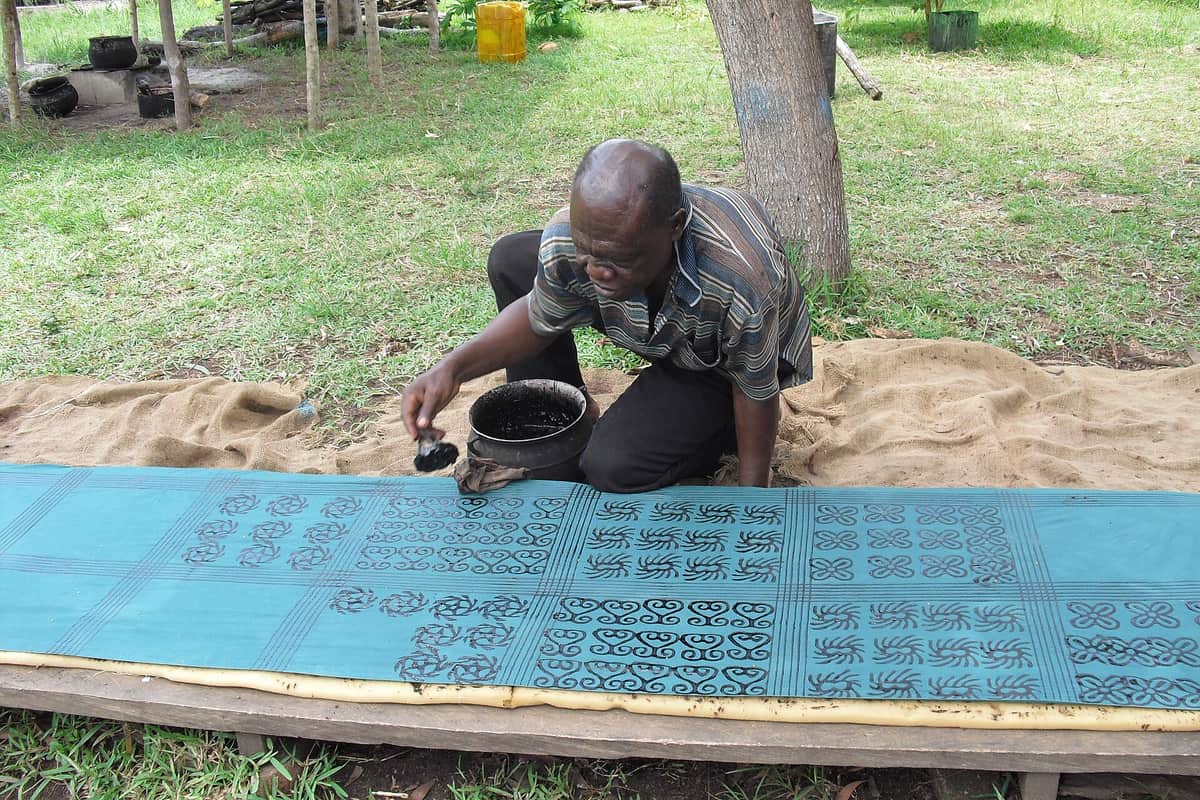
Indigenous knowledge systems in Ghana shape everyday decisions far more than official statistics suggest. A farmer in the north decides when to plant by watching the trees and the sky. A coastal community leaves a stretch of mangrove alone because tradition forbids harvesting there. A family treats illness with herbs whose uses have been passed down for generations. A weaver in Bonwire works a pattern that has its own name and meaning. This working paper sets out what the published evidence says about these systems: some examples, the evidence of their value, and how Ghanaian law protects, or fails to protect, them.
The paper draws only on published sources: peer-reviewed research, laws, official records and reputable reporting. It does not present new field data. Where the evidence is limited, the paper says so.
What is indigenous knowledge?
This paper uses "indigenous knowledge" to mean the knowledge that communities build up over generations through observation, practice and experiment in a particular place, and pass on through families, apprenticeship and custom. Researchers who study local weather forecasting in Ghana describe it in these terms: such knowledge follows a rigorous process based on observing biophysical indicators and experimenting, in order to build trusted cause-and-effect relationships between the signs and what they predict (Gbangou et al., 2021, citing earlier work).
Ghanaian law has its own vocabulary. The Copyright Act, 2005 defines "folklore" as "the literary, artistic and scientific expressions belonging to the cultural heritage of Ghana which are created, preserved and developed by ethnic communities of Ghana or by an unidentified Ghanaian author", and states that it "includes kente and adinkra designs, where the author of the designs are not known". The word "scientific" in that definition is worth noticing: the law recognises that heritage includes knowledge about the world, not only art.
How do farmers read the weather?
Weather forecasting is one of the best-documented indigenous knowledge systems in Ghana, and one of the most practical. Ankrah and colleagues surveyed 240 farmers in six districts across the Northern, Western and Volta regions. Farmers named indicators including the arrival of migratory birds, the direction in which clouds form, the intensity of the sun, the croaking of frogs, and the sprouting of new leaves on trees such as shea, baobab, emire and tarmeranda (Ankrah et al., 2022).
Researchers group these signs into four spheres: atmospheric conditions, celestial elements, animals and plants. Some are used for the next day's weather; others for the season ahead. In Ada East District, on the coastal savannah of the Volta delta, farmers used them to predict whether it would rain, how much rain a season would bring, when dry spells would occur, and when the rainy season would start and end. Over 105 days of recorded observations in 2019, the signs seen most often were the sun, clouds, birds, wind, dew, ants, frogs and the halo, each observed more than 25 times (Gbangou et al., 2021).
These forecasts are widely used. In Kumbungu District in the Northern Region, Nyadzi and colleagues surveyed 108 farmers in twelve communities. Sixty per cent said they always used indigenous forecasts and 35 per cent very often; none said they rarely or never did. Scientific forecasts were also used, but differently: 7 per cent always and 74 per cent very often (Figure 1). In a separate study across northern Ghana, 71 per cent of farmers relied on traditional knowledge to forecast the onset of the rains (Atiah et al., 2021, discussed in RFI Working Paper No. 2). Kumbungu lies in the Guinea savannah; about 95 per cent of its households are engaged in agriculture, and 69 per cent of the farmers in the sample had no formal education (Nyadzi et al., 2022). The authors found that, in northern Ghana, forecast information from the meteorological agency was not acceptable to many farmers, which made them rely on indigenous forecasts for their decisions.
Part of the reason is that scientific forecasts have their own weaknesses at the scale where farmers work. Gbangou and colleagues note, citing earlier studies, that scientific forecast information often has limited skill and accuracy at the local scale, and that the way farmers understand and accept modern forecasts can limit how useful they are. A national forecast for a region may say little about one valley or one farm.
Farmers do not see indigenous forecasts as inferior. In Ada East, one of the hottest districts in Ghana and a major source of vegetables for Accra and Tema, Gbangou and colleagues asked farmers how reliable they found each kind of daily forecast. Forty per cent rated local forecasts reliable, compared with 22 per cent for the national scientific forecasts; most rated scientific forecasts only "somewhat reliable" (Figure 2).
The same study then tested the forecasts against rainfall measured in the communities. Farmers were trained to record indicator observations with digital tools and rainfall with gauges over 105 days in 2019. The results showed that a set of local indicators used together predicted next-day rainfall better than any single indicator, and could potentially outperform the Ghana Meteorological Agency's forecasts for the district (Gbangou et al., 2021). Ankrah and colleagues, comparing reliability across their six districts, obtained an index of 0.72 for indigenous predictors and 0.88 for science-based predictors, and concluded that both were reliable (Ankrah et al., 2022).
The most promising results come from combining the two. In Kumbungu, Nyadzi and colleagues developed an integrated forecast that merged indigenous and scientific forecasts into a single probability. At the daily timescale it performed on average better than either source alone. Ninety-three per cent of the farmers already combined both kinds of forecast informally, comparing them against their own experience, and 93 per cent preferred an integrated forecast; 96 per cent said they would accept information from it (Nyadzi et al., 2022). A caution came with this: 99 per cent said they would use the integrated forecast only if it proved reliable. At the seasonal timescale, both the integrated and the indigenous forecasts performed better than the scientific forecast. Asked to compare methods of integration, 75 per cent preferred the integrated probability method because their own knowledge was built into the forecast and fewer meetings were needed, while 25 per cent favoured a consensus approach that engaged them continuously in learning, even though it took more time (Nyadzi et al., 2022). Ankrah and colleagues drew a similar policy conclusion: governments could task meteorological stations with using both indigenous and science-based predictors in their daily forecasts (Ankrah et al., 2022).
How has indigenous knowledge protected forests and wildlife?
Across Ghana, communities protect certain forests, rivers and animals through beliefs, taboos and totems. Sacred groves are remnants of forest believed to be the abode of ancestral spirits and deities, protected from open access by traditional rules such as taboos (Poreku, 2014). In the Dagbon and Mamprugu traditional areas of northern Ghana, communities give groves this special status because they are believed to be the abode of deities and spirits; in the Tolon District, the groves are owned by the communities but held in trust by the chiefs.
Ntiamoa-Baidu examined the effectiveness of these systems. The Nkodurom and Pinkwae sacred groves had been preserved by local communities through beliefs enforced by a range of restrictions and taboos; in both cases, the grove was the only relatively intact forest in a landscape of severely degraded land and farms. Along the coast, the mangrove periwinkle Tympanotonus fuscatus, three species of sea turtle and the Black heron are exploited by many communities but protected by some through traditional beliefs. Where they were protected, numbers were much higher: periwinkle densities ranged from 172.3 to 326.2 per square metre at the protected site, against 46.7 at an exploited site, and over 80 per cent of all turtle nest records and 54 per cent of Black heron sightings were at traditionally protected sites (Ntiamoa-Baidu, 2008; Figure 3).
The same systems operate in the north. A study for the UNU Land Restoration Training Programme identified four sacred groves in three communities of the Tolon District, holding 29 plant species, four of them listed as threatened, and 23 wild animal species, one of them threatened (Poreku, 2014). The report notes, citing earlier research, that strangers on the land are taught the taboos protecting particular plants and animals, and that offenders can be punished by banishment or a fine. It also records the pressures: increasing population and demand for resources have made the use of groves harder to manage and, according to earlier studies, have reduced the size of some groves. Elders in Tolon complained of shrinking groves and the loss of valuable plants and animals, but the author found no scientific evidence to confirm or measure this, and designed the study as a baseline against which future change could be measured. The report recalls three strategies proposed by Ntiamoa-Baidu and colleagues in 1992: legislation to strengthen traditional management of access and use, resources to support local people in managing their groves, and an inventory of all sacred groves in Ghana and the biological resources they contain.
Ntiamoa-Baidu called for a global assessment of indigenous conservation systems, and for promoting those with the potential to support biodiversity conservation in Africa. The evidence suggests that these systems are not relics but working institutions, with rules, enforcement and measurable results, which modern conservation can support rather than replace.
How do farmers use indigenous techniques on the land?
Indigenous knowledge also shapes how land is farmed. In the Lawra District of the Upper West Region, Akugre and colleagues found that 45.6 per cent of farmers used zai, a traditional soil nutrient and water conservation technique based on small planting pits, and 44.4 per cent practised agroforestry, alongside crop rotation and changes to planting dates (Akugre et al., 2021, discussed in RFI Working Paper No. 3). Ankrah and colleagues found that both indigenous and science-based predictors influenced how farmers adapted, including through cultivating indigenous varieties, planting early or late, diversifying crops and using improved and drought-tolerant varieties (Ankrah et al., 2022). In practice, farmers mix knowledge systems rather than choosing between them.
How has herbal medicine been brought into the health system?
Herbal medicine is part of Ghana's traditional medical system, which includes herbalists, priests and traditional healers (Appiah et al., 2018). Its place in health care is not unique to Ghana. Appiah and colleagues cite the World Health Organization's estimate that 80 per cent of the world's population use herbal medicines, and note that some countries, such as China, have integrated herbal and biomedical medicine, with traditional medicines covered by public and private insurance at every level of care. They also note a source of tension: some Western-trained health workers may regard herbal remedies as harmful to patients. Over two decades, the State has taken steps to bring it into formal health care. Appiah and colleagues list several. In April 2001, the Ministry of Health established a Traditional and Alternative Medicine Directorate, and in 2005 the country launched a new policy on the practice of alternative medicine. In 2001, the Kwame Nkrumah University of Science and Technology (KNUST) began a bachelor's programme in herbal medicine, and by 2012 it had trained 112 medical herbalists. Recommendations were made for public hospitals to prescribe some herbal medicines. And in 2011, the government began a pilot to integrate herbal medicine units into 17 public hospitals.
Appiah and colleagues interviewed 25 key informants about the pilot. Most supported integration. They cited as strengths the employment of medical herbalists, the use of traditional knowledge, research opportunities, and efficient service delivery through restricting the prescription and use of fake herbal medicines. The weaknesses were serious: the lack of government policy on implementing integration, financial difficulties because the National Health Insurance Scheme did not cover herbal medicine, so that patients paid out of pocket, weak advocacy and research, and a lack of training in herbal medicine for conventional health workers. Informants also noted that although the need for herbal medicine was greater in rural areas, the integration had mostly taken place in urban hospitals (Appiah et al., 2018).
How are kente and adinkra protected?
Kente, the woven cloth, and adinkra, the stamped symbols, are among the best-known expressions of Ghanaian knowledge. Both are named in the Copyright Act's definition of folklore. The Act protects expressions of folklore against reproduction, communication to the public and adaptation without permission (section 4(1)), and vests the rights in the President "on behalf of and in trust for the people of the Republic" (section 4(2)). These rights exist in perpetuity (section 17). The Act establishes a National Folklore Board to administer, register and monitor the use of folklore (section 59), and requires anyone wishing to use folklore beyond the permitted uses to apply to the Board and pay a fee (section 64). The fees go to a fund for preserving and promoting folklore and indigenous arts. Selling copies of works of folklore, or adaptations of folklore made outside Ghana, without the Board's written permission is an offence (section 44).
The Board has explained what this means in practice: personal use, news reporting, educational use and use within the customary context do not require permission, so that a musician using proverbs in a song or a trader selling kente cloth for a living does not need the Board's approval (Ghana News Agency). Commercial users of Ghanaian folklore must apply.
Kente is also a livelihood. Ghana has five major kente production hubs across two regions, and weaving is often passed down within families. Reporting from the weaving communities shows how thin margins can be: one weaver with 21 years at the loom said that cloth selling for about GH¢2,500 in Ghana could fetch more than the equivalent of GH¢4,000 in neighbouring Burkina Faso, and that he was considering taking his skills there (Akakpo, 2026).
Copyright has limits. Artisans and industry participants have long complained that labour-intensive handwoven kente designs were copied and reproduced commercially on other fabrics, in Ghana and abroad, without adequate benefits reaching the original weavers (Akakpo, 2026). Ghana has now added another layer of protection. Kente weaving was inscribed on UNESCO's Representative List of the Intangible Cultural Heritage of Humanity in December 2024, and in August 2025 kente became Ghana's first protected geographical indication, a status that ties the name to its places and standards of production. The head of geographical indications at the Registrar-General's Department has explained that, after the registration of a national weavers' association, the next steps are structured membership, training and inspections, and that weavers may use the approved tag only when standards are met. Reporting on the Ghana Export Promotion Authority's figures, the same account notes that kente export values rose from about US$6,256 in 2023 to US$38,902 in 2024, an increase of 522 per cent (Akakpo, 2026). These are small sums, but they suggest a market that protection could help grow.
Figure 4 places these steps in sequence with the other milestones discussed in this paper.
- 2001: herbal medicine enters the universityKNUST begins a bachelor's programme in herbal medicine; by 2012 it had trained 112 medical herbalists.
- 2005: folklore protected by lawThe Copyright Act vests rights in folklore, including kente and adinkra designs, in the President in trust for the people, in perpetuity, and creates the National Folklore Board.
- 2011: herbal medicine in public hospitalsA government pilot integrates herbal medicine units into 17 public hospitals.
- 2019: genetic resources and benefit-sharingGhana ratifies the Nagoya Protocol (in force for Ghana from 6 November 2019). National legislation was still being developed in 2022.
- 2024–2025: kente recognisedKente weaving is inscribed on UNESCO's Representative List (December 2024) and becomes Ghana's first protected geographical indication (August 2025).
Selected milestones only. Each step protects a different thing: university training and hospital units build on knowledge, copyright protects expressions, benefit-sharing covers genetic resources, and a geographical indication protects a product's name and origin.
Source: RFI, drawing on Appiah et al. (2018), the Copyright Act, 2005 (Act 690), the UN depositary notification C.N.382.2019, the Ghanaian Times (2022) and Bird Story Agency via AllAfrica (2026).
What about knowledge linked to plants and genetic resources?
Much indigenous knowledge concerns plants: which ones heal, which feed animals, which resist drought. When researchers or companies use such knowledge to develop products, the question of who benefits arises. The international framework for this is the Nagoya Protocol on access to genetic resources and the fair and equitable sharing of benefits, which also covers traditional knowledge associated with those resources (Convention on Biological Diversity). Ghana ratified the Protocol on 8 August 2019, and it entered into force for Ghana on 6 November 2019 (United Nations, 2019).
Ratification is not the same as implementation. In 2022, the Minister for Environment, Science, Technology and Innovation said that legislation was being developed so that Ghana could obtain its fair share of benefits, and a ministry official described the country as "moving towards legislation" on access and benefit-sharing. The director of the CSIR Plant Genetic Resources Research Institute reported that between 2019 and 2022 Ghana had approved four applications for access to genetic resources (Ghanaian Times, 2022). The law protecting folklore protects expressions; it does not clearly protect the underlying knowledge of how a plant can be used.
How do these knowledge systems connect?
It is tempting to treat weather lore, sacred groves, herbal medicine and kente as separate subjects. The evidence suggests they are connected, and that the connections matter for policy.
Many of the indicators farmers use to forecast rain are living things: shea and baobab leaves, frogs, ants, migratory birds. The same trees and animals depend on landscapes that sacred groves, taboos and customary land rules help to protect. Herbal medicine, too, depends on plants, and on people who know where to find them and how to use them. Sacred groves in the north are held in trust by chiefs on behalf of communities, which links them to the customary land system described in RFI Working Paper No. 3. And as discussed in RFI Working Paper No. 2, the farmers who rely most on indigenous forecasts are those most exposed to climate change.
When one part of this web weakens, others are affected. Clearing a grove removes habitat, medicinal plants and, potentially, forecasting signs at once. A policy that protects kente designs but ignores the farmers whose knowledge of the seasons sustains rural livelihoods protects only part of the system. Indigenous knowledge is best understood, and best protected, as a set of relationships between people, places and living things, rather than as a collection of separate items.
What threatens indigenous knowledge?
The evidence points to several pressures. Climate change itself can erode forecasting knowledge: researchers note claims that trust in local forecasting is declining because indicators are lost as weather and climate change, and farmers in Ada East themselves recognised a decline in confidence in local forecasting knowledge (Gbangou et al., 2021). Atiah and colleagues found that the adaptation measures farmers applied were not always consistent with actual rainfall seasonality (see RFI Working Paper No. 2). Rising population and demand for resources press on sacred groves (Poreku, 2014). Herbal medicine sits outside health insurance (Appiah et al., 2018). And copying of designs moves value away from the communities that created them (Akakpo, 2026).
None of this means indigenous knowledge is fading in importance. It means that knowledge which was once maintained mainly through custom now needs support from public institutions as well.
What would strengthen indigenous knowledge systems?
The evidence suggests several directions. They are implications of the published research, not tested programmes.
Integrate, do not replace. The forecasting studies show that combining indigenous and scientific knowledge can outperform either alone, and that farmers want this. Climate information services could build local indicators into their products, as Nyadzi and colleagues demonstrated, and report back on how well forecasts performed.
Support community conservation. Sacred groves and taboos protect real biodiversity. Formal conservation can recognise and support these institutions, for example through mapping groves, supporting community rules and involving traditional authorities in planning.
Finish the integration of herbal medicine. A clear policy on herbal units, decisions about insurance coverage for proven treatments, training for conventional health workers, and extension to rural hospitals would address the weaknesses identified in the pilot.
Turn protection into income. The geographical indication for kente and the Folklore Board's licensing system only matter if weavers and communities benefit. Fast registration of producers, fair standards, and transparent use of folklore fees for communities would make protection real.
Legislate for benefit-sharing. Completing national legislation under the Nagoya Protocol would give communities a route to share in benefits when their knowledge of plants is used.
Document with consent. Recording indigenous knowledge can help preserve it, but communities must control what is recorded and how it is used, so that documentation does not become a route to misappropriation.
What are the limits of this paper?
This is a review of published evidence. The studies cited cover particular districts, communities and periods, and indigenous knowledge varies greatly between Ghana's many peoples. The forecasting studies are small, and reliability depends on the season and indicator. The account of kente's geographical indication relies on news reporting of official statements rather than on the registration documents themselves. The paper discusses only a few domains; it does not cover, for example, indigenous architecture, food processing, music or governance, each of which deserves its own study.
Conclusion
Indigenous knowledge systems in Ghana are not a heritage of the past to be admired from a distance. They are working systems: farmers use them to plan their seasons, communities use them to protect forests and wildlife, families use them to heal, and weavers use them to make some of the world's most recognised cloth. The evidence shows that they can be accurate, that they are widely trusted, and that they work best when connected with science rather than set against it. Ghana has built some protections, from the folklore provisions of the Copyright Act to kente's geographical indication, but many are partial. Strengthening indigenous knowledge means supporting the people who hold it, sharing its benefits fairly, and allowing it to keep learning, as it always has.